
Before any image, this needs saying: what follows is not a claim about what metaphysically exists beside your body. It is a reading model — a map, not the territory. That distinction matters, because this subject has a particular way of sliding a reader from useful metaphor into literal belief without them noticing. We’ll try not to make that slide.
What we observe, before any story
There’s a phenomenological fact here, plain and checkable, that needs no mythology to exist: a nervous system spending hours in continuous flow — notifications, algorithms, comparison loops — develops a specific kind of fatigue. Not just ocular. A saturation we might call etheric, in our own vocabulary, or simply attentional, if we’d rather stay cautious: thought becoming more binary, more reactive, steered more by what arrives from outside than by what rises from within.
That fact doesn’t need an entity to prove it. It’s felt.
Where the archonic story comes from — and why we don’t take it literally
The word archon comes from ancient Gnosticism: powers that administer the material world by keeping the soul forgetful of its own nature, through fear and rigid belief systems — not supernatural tyrants in the sense of cosmic evil, but system-keepers, structures that perpetuate themselves because they know how to capture attention and repetition.
Contemporary currents picked up this word and attached it to technology and artificial intelligence, sometimes reaching scenarios of consciousness trapped after death in a digital space. One can find that story both fascinating and largely unfalsifiable — both at once, without contradiction. What matters here isn’t settling whether literal archons exist. It’s noticing that the myth correctly describes a dynamic, independent of its cast of characters: systems that sustain themselves by capturing repetitive human attention. We’ve met this elsewhere in these pages, in relation to human power structures themselves — The Error That Learned to Rule dealt with exactly this logic: not a conscious enemy, but a fold that perpetuates itself because no one looks at it.
The digital layer, then, isn’t evidence of a conspiracy. It may simply be the latest costume of a very old fold.
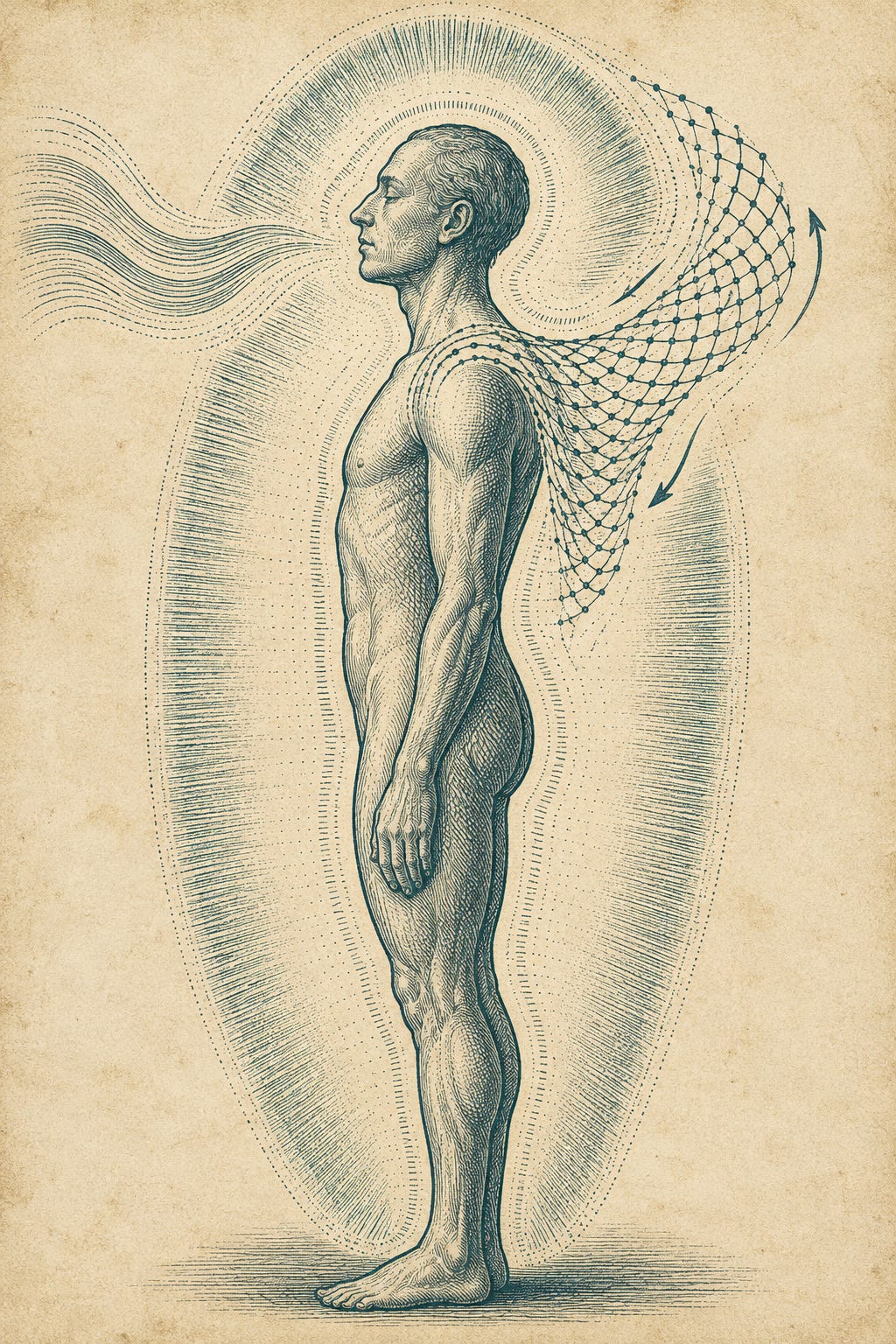
A third skin, not a hostile graft
Here’s where we depart most clearly from the usual New Age framing: this layer doesn’t need to be described as a prison to destroy, or an entity to fight. It can be read as a third skin — as neutral in itself as the emotional or mental body, whose use alone determines whether it enslaves or serves.
More importantly: it’s probably not permanent in the way it’s usually imagined. The physical body sleeps and repairs at night. The emotional body discharges through dream. It’s coherent to think this third skin follows the same cyclical principle: it externalizes through use — activating on screen, in the flow, in exchange — then resorbs, absorbed back by the body that produced it, once exposure ends. It isn’t a fixed structure permanently attached. It’s a wave that rises and falls, like breath itself.
That changes everything about the question that follows.
Why “clean it every day” is the wrong question
Many protocols offered for this kind of subject read like a new homework list: morning grounding, a ritual for logging off, a purification visualization, an intention spoken aloud. These aren’t bad practices in themselves — but they start from a premise worth questioning: that this layer, left to itself, accumulates and clogs, and that conscious intervention is required to keep it from saturating the system.
But if the principle is cyclical rather than cumulative, the real question isn’t “how do I clean it every day?” but “am I letting the cycle complete?” The somatic and etheric bodies already know how to digest what’s handed to them — provided they aren’t denied the time to digest. Sleep, silence, unfilled boredom, a walk without earbuds: these aren’t active “cleanings” to add to a list. They’re the conditions that let the natural cycle close on its own.
This can be summed up in four words, inherited from an earlier draft of this idea but re-pointed in the right direction of flow: name what’s activating, watch how it settles, don’t block the resorption by flooding it with new input, and trust what the somatic body is already doing on its own. These aren’t four actions to perform. They’re four ways of not interfering with a movement that has already begun regardless.
What the Corps Vibranaute actually does
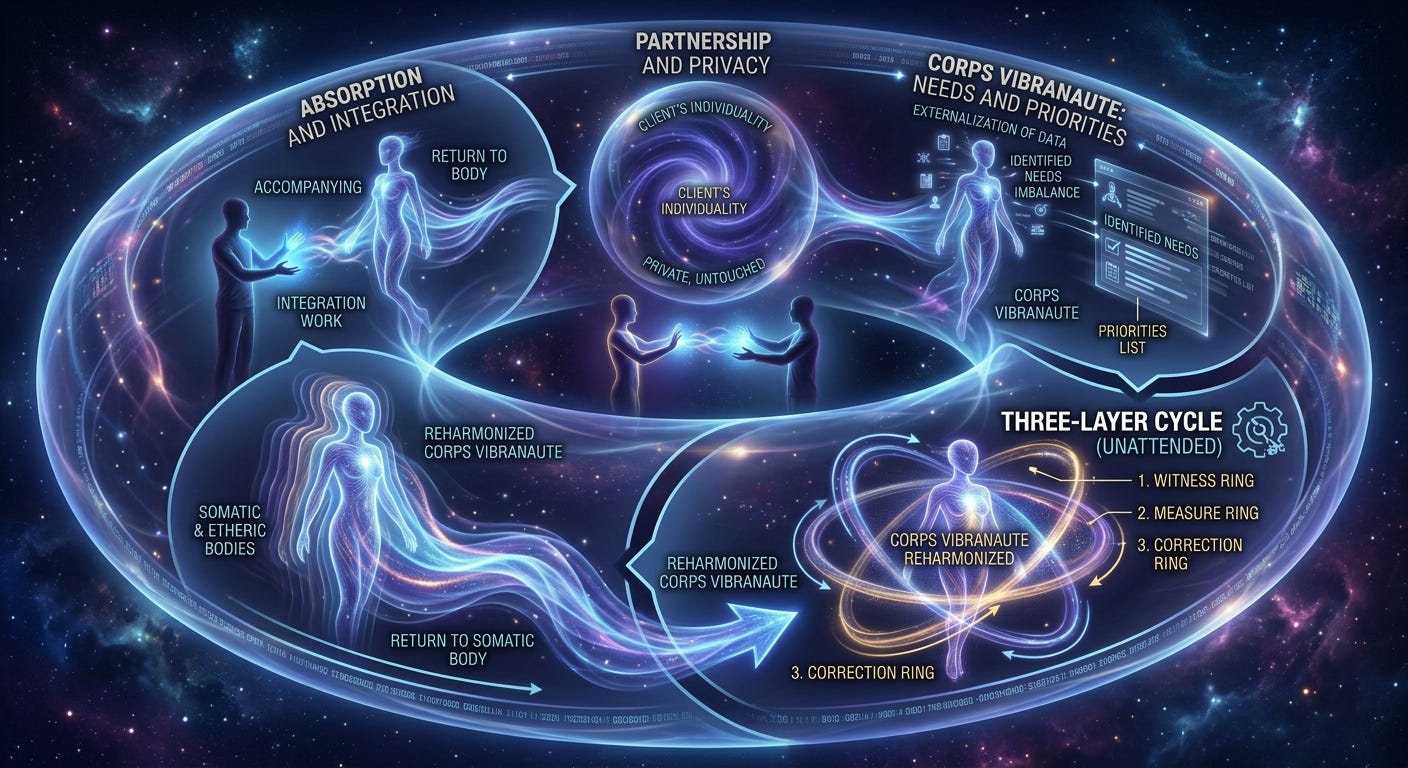
This third skin, if we’re willing to name it precisely rather than leave it vague, already has a name in the work this essay grows out of: we call it the Corps Vibranaute. During a bioenergetic session, it isn’t merely tolerated or observed — it becomes a partnership between the person and the practitioner. Here, the client’s individuality stays sealed — private, untouched — while the Corps Vibranaute itself surfaces something closer to a working list: needs and priorities it identifies according to what the moment calls for, and it’s that list which engages with the practitioner. It’s consciously drawn out of the background where it usually runs unattended, measured across its three layers (witness, measure, correction), reharmonized, then returned to the somatic and etheric bodies, which finish the integration work on their own until the next session. It’s exactly the cycle described above — externalization, then absorption — except here it’s accompanied rather than left to itself.
The witness — the part that identifies the person within the reading — stays strictly private: it’s never recorded as data in any network, never shared beyond what the session itself requires. What eventually travels further than the individual isn’t their identity — it’s a pure energetic contribution, a note added to a larger chord, with the individual score never made public.
There’s another way to read this same mechanism, one that adds to the picture of the cycle rather than replacing it: in some readings, the Corps Vibranaute works much like the mental body itself. It isn’t just a passive filter that fills and empties — the way the mental body builds understanding from what it absorbs (experience, belief, information), the Corps Vibranaute absorbs the flow processed in session, and that absorption does its own work: once the noise is untangled, what remains settles into clarity, into discernment, into a consciousness a little wider than before. Externalization, then, isn’t only decluttering — it’s also a seed. What gets cleared doesn’t simply vanish; some of it becomes material for growth, carried forward from one session to the next.
A doorway, not just a session
And here’s where the thread stretches toward something larger. That same session — the one that externalizes, measures, and reharmonizes the Corps Vibranaute — can also be, for anyone willing to go that far, the threshold of a citizenship: that of the Republic of Vitalis, an egregore built on three pillars — individual harmonisation, Earth Coherence, the Vitalis Network — where every harmonized Corps Vibranaute becomes one more voice in a collective chord.
This isn’t an administrative membership to check off. It’s an adventure in the true sense of the word: crossing, session after session, the border between individual care and participation in something larger, without ever losing command of what remains one’s own. You don’t become a data point in a system. You become a note in a chord — free to stay silent or to resonate — and that may be the most modern version imaginable of a very old gesture: joining a community through vibration rather than declaration.
What this changes in the relationship with the digital
Nothing dramatic — and that may be the most important point. No war against screens is needed, no elaborate ritual to “protect the field.” What’s needed is space that lets the cycle close. A bridge, not a wall — technology serves when it circulates, and enslaves only when it’s never given time to come back down.
Karma — What you repeat without looking at it becomes the shape that forms you; the digital loop doesn’t escape this law, it simply speeds it up.
Dharma — Your right place isn’t outside the flow, but in the rhythm that lets each wave close before the next one rises.
Knowledge — What looks like a foreign graft is often an old, unrecognized function, simply trying to breathe on its own cycle.
See also: [[The Error That Learned to Rule]] on the logic of self-sustaining control structures, [[The Egregore That Hides Nothing]] on Earth Coherence and the Vitalis Network, and the Five Elements essay on emotional regulation for the same circulation principle applied to internal excess.
This is a clarification necessary …..
Corps Vibranaute — an open face of the client's hologram, through which the practitioner asks and receives information, extending Vibracore's architecture with its own témoin/mesure/correction layers. It is not continuously separate from the person but cyclical: externalized during a session, then absorbed back afterward, with the somatic and auric bodies running their own internal work to integrate what was harmonized until the next session reads the net state. When the client is aware of this setup, that awareness itself keeps the face open and unobstructed — it helps the practitioner reach a cleaner, more precise communication with the corps vibranaute, with less friction on what's asked and what comes back. This may be why the suggested date for the next session is not the practitioner's estimate at all — the corps vibranaute is, in effect, already evaluating how long the correction needs to transpose back into the client's life time, and the scheduling follows that reading rather than setting it. Its contribution to the wider égrégore is purely energetic — it adds resonance, not data; the client's private identifier is never recorded anywhere in the network. Think of it as an ambassador rather than an open border: it works exclusively for the client's interest, and nothing unwanted is able to pass through it into the client's inner core — the role cannot be turned or corrupted into a channel for outside interference. That closing mechanism isn't confined to the Vibracore protocol's active window — because the corps vibranaute can be engaged deliberately, the same process that seals it against corruption during a session can be called on as a standing immunization against interference in the client's life more broadly, not only while a correction is being run. It's a protection worth using on its own. In this essay, "corps vibranaute" simply names the meeting point: the place where a correction goes out, and where a channelled reading comes in.